Operations
Lead with power. Build with speed. Scale with discipline.
Three principles, and a team with the background to execute them. Z Squared pairs deal leadership that sources and structures energized-site transactions with technical leadership that has designed and operated high-density digital infrastructure.
Building the Portfolio
Z Squared acquires sites where power is already flowing and converts them into infrastructure built for AI and high-performance compute. Z Squared has closed the acquisition of Paradox Data, LLC, bringing the Union County Campus into that portfolio.
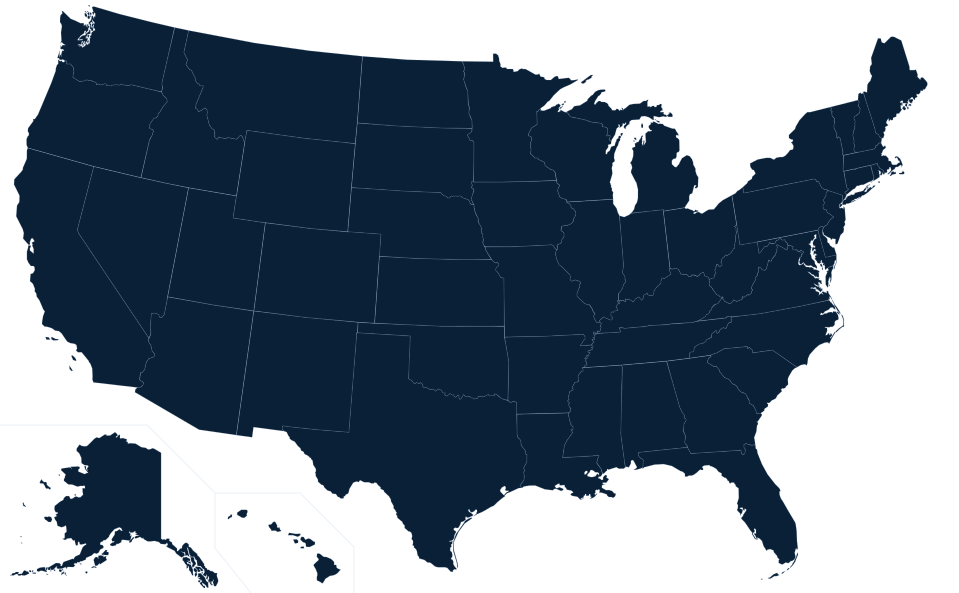
El Dorado, Arkansas
Union County Campus
Closed Sept. 8, 2026

Z Squared has completed the acquisition of 100% of Paradox Data, LLC. Paradox Data’s principal asset is the Union County Campus at 713 Industrial Road, El Dorado, Arkansas. The campus has electric service already flowing under an existing interruptible service arrangement with Entergy Arkansas for up to approximately 8.0 MW. Paradox Data, now a wholly owned subsidiary of Z Squared, also holds contractual rights to acquire adjacent land and a development pathway targeting 150+ MW of AI-ready capacity over time through a combination of utility power and on-site generation. Capacity above the existing service arrangement is a development target and is not currently contracted, energized, or delivered.
Sourcing and structuring is the hard part
Energized sites do not come to market on a listing service. They are found through relationships, evaluated on power economics before anything else, and won by structuring a transaction the seller will actually sign. That is the discipline Z Squared is built around.
The Deal Team
David Halabu
Chief Executive Officer
David Halabu, Chief Executive Officer. Founder and Managing Partner of Group 10 Capital Management, with a background in capital markets, real estate acquisitions, and deal structuring. At Z Squared his role is to source, structure, and close the transactions that bring new assets onto the platform.
Every announced transaction to date has been structured entirely in convertible preferred stock: no cash consideration, no debt financing. The structure preserves the balance sheet, conserves capital for operational deployment, and aligns the counterparty with the long-term outcome of the company.
Building it is the other hard part
Direct liquid cooling is increasingly central to high-density AI environments, enabling higher rack densities and improved energy efficiency. That capability comes into the platform with Paradox.
Technical Leadership
Jeffery Harris
Chief Technology Officer
Jeffery Harris, Chief Technology Officer. Founder of Paradox Data and the architect of the Union County Campus. His background is in high-density compute, the cooling architecture that makes the densest AI and HPC deployments viable, and the discipline that separates a powered building from a data center.
Five questions, in this order
Most sites fail on the first one. The order matters, because a site that fails early is not worth diligencing further, and speed in this market comes from saying no quickly.
1. Is the power already flowing?
Energized, grid-connected capacity is not subject to the interconnection queue. A greenfield campus applying today may wait three to five years for commercial power. An operating site can be converted in months. This is the gate everything else sits behind.
2. What does the utility relationship actually permit?
Existing service arrangements, expansion rights, and letters of authorization determine whether a site has a real path to more capacity or just a nameplate figure. We underwrite the documented path, not the aspiration.
3. Can the site take density?
Power on a meter is not the same as power at the rack. Cooling architecture, electrical distribution, floor loading, and thermal headroom determine what the site can actually host, and what a conversion will cost.
4. Is the connectivity real?
High-bandwidth, low-latency, carrier-diverse fiber is the second gating input after power. Power without fiber is industrial capacity that cannot serve AI workloads at production speed.
5. Does the jurisdiction want this?
Zoning, permitting posture, incentive eligibility, and local support determine whether a development timeline is achievable or theoretical. This is the diligence item most often underweighted, and the one most likely to stop a project after capital is committed.
Own an energized site?
We acquire operating, grid-connected power sites and convert them. If you hold one, we should talk.